Livingborderlessly
Latest News
|Livingborderlessly
Latest News

Subscribe

Digital Nomad Aruba Guide for Life and Work in Aruba

|

Livingborderlessly

Archives

Digital Nomad Aruba Guide for Life and Work in Aruba

SIGN UP FOR OUR NEWSLETTER

Digital Nomad Aruba Guide for Life and Work in Aruba

Explore remote work aruba and aruba digital nomads tips

Aruba, a constituent country of the Kingdom of the Netherlands, is emerging as a prime destination for digital nomads seeking a blend of modern infrastructure and Caribbean charm.


Located just 15 miles off the coast of Venezuela, Aruba boasts a reliable power grid and high-speed internet, ensuring seamless remote work experiences.


Its position outside the hurricane belt provides stable, sunny weather year-round, making it an attractive option for those looking to escape unpredictable climates.


The Truth


Most people think Aruba is only for week-long vacationers staying in all-inclusive resorts. Aruba reveals a sophisticated island with fiber-to-the-home internet, a growing community of remote professionals, and a government actively welcoming long-stay visitors. This is the Caribbean's most connected hideaway, offering modern infrastructure, year-round sunshine, safety that rivals suburban America, walkable neighborhoods near the beach, and a multicultural vibe where Dutch, Caribbean, and Latin influences blend seamlessly.


A professional in New York pays $4,500 monthly for a one-bedroom apartment in a trendy Manhattan neighborhood, often without utilities or parking included.


Making $120,000 annually, but after rent, subway costs at $127, health insurance at $600, and income tax at $24,000, saving barely happens.

Remote workers in Aruba's best district, Noord near Palm Beach, pay $2,200 for a furnished one-bedroom apartment with fiber internet, a pool, and air conditioning. The scent of salt air drifts through your windows as you work from your private terrace overlooking swaying palm trees.


"I moved for the sunshine and safety," one remote worker shared in Aruba expat forums. But Aruba surprised me with the community. I found weekly networking events at Impact Hub, made friends with expats from all over the world, and actually feel more productive here than I ever did in London. The trade winds keep me energized, and I spend zero time commuting. Aruba delivers focus, community, and genuine work-life balance.


Same income. Different costs. That is LivingBorderlessly. Different unique quality: the opportunity to live intentionally in a place where modern infrastructure eliminates the friction of remote work, allowing you to focus on what matters while the Caribbean rhythm naturally encourages balance between productivity and presence. This is geoarbitrage.

What's the cost?

Budget-Friendly Stays and Visas

Can You Legally Do This?


One Happy Workation: This is not a formal digital nomad visa but a tourism initiative designed to attract remote workers for extended stays. US citizens and many other nationalities can enter visa-free for up to 90 days. The program encourages stays of this duration by partnering with hotels and rental agencies to offer work-friendly accommodations with reliable internet. The application fee is $305 for those seeking official program participation, though standard tourist entry requires no fee. Participants must prove they have employment or income from outside Aruba and must not compete with the local labor market.


Extension of Stay: If you wish to stay beyond the initial 90-day period, you can apply for an extension through DIMAS, the Aruban immigration department. Extensions can allow you to stay for up to 180 days total per calendar year. The process requires submitting documentation, including proof of sufficient funds, valid health insurance, and a clean criminal record. Fees vary, and approval is not guaranteed, so it is wise to apply well before your initial 90 days expire.


💰 The Real Numbers


Daily Average: $85 to $150 per person, per day ➙ Monthly Average: $2,500 to $4,500, $1,500 to $3,000


Monthly Cost Breakdown for Aruba vs. New York

 
Category New York, USA Aruba, Aruba Monthly Savings
Accommodation: one-bedroom in trendy district $4,200 $1,800 $2,400
Food: mix of local markets and dining $800 $700 $100
Transportation: subway vs. car rental $127 $500 -$373
Health Insurance: comprehensive coverage $600 $150 $450
Utilities: electricity, water, internet $200 $180 $20
Entertainment: dining out, excursions $400 $350 $50
Income Tax (Annualized monthly) $2,000 $0 $2,000
TOTAL $8,327 $3,680 $4,647
ANNUAL SAVINGS:     $55,764


What's happening?

Things to Do in  Aruba

Key Experiences


Eagle Beach and the Famous Fofoti Trees 🌴


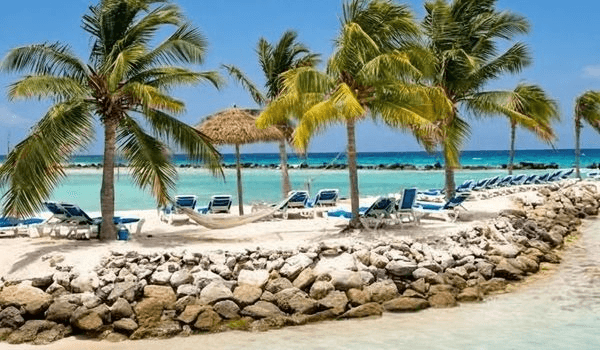
Eagle Beach consistently ranks among the best beaches in the world, and for good reason. The sand is soft and powdery white, the water is impossibly clear turquoise, and the iconic fofoti trees bent by the trade winds create the perfect photo opportunity. Unlike Palm Beach with its high-rise hotels, Eagle Beach remains relatively undeveloped, offering wide-open spaces where you can find your own quiet spot even on busy days. Arrive early in the morning before 9 AM to claim a spot under the divi-divi trees and watch the sunrise paint the sky in shades of pink and orange. The beach is free to access, and you can rent chairs and umbrellas for $15 to $20. This is where locals come to unwind after work, making it a perfect spot to transition from laptop to leisure.


Arikok National Park and the Natural Pool 🏜️


Arikok National Park covers nearly 20 percent of Aruba and protects the island’s rugged, wild side. Here, the landscape shifts dramatically from white sand beaches to rocky coastline, desert-like terrain with cacti, and ancient Arawak cave paintings. The park’s crown jewel is the Natural Pool, or Conchi, a hidden swimming hole formed by volcanic rock that protects swimmers from the crashing waves. Reaching the pool requires a four-wheel-drive vehicle and a willingness to navigate bumpy, unpaved roads. The journey is worth it. You will swim in crystal-clear water surrounded by dramatic rock formations while waves crash against the outer walls. Entry to the park costs $15, and guided tours are available if you prefer not to drive yourself. Visit early morning or late afternoon to avoid the heat and the crowds.


Snorkeling with Sea Turtles at Tres Trapi 🐢


Tres Trapi, also known as Arashi Beach, is a small cove on the northwest coast that has become famous for its resident sea turtles. The name refers to the three natural stone steps carved into the rocks that provide easy entry into the water. This spot is a local secret that has gained popularity among travelers seeking to swim with turtles in their natural habitat. The best time to visit is early morning before tour boats arrive. Bring your own snorkel gear, as rentals are not available on-site. Swim slowly and quietly along the rocky shoreline where turtles graze on seagrass. You will likely encounter several turtles, and if you are lucky, you might also spot octopus, starfish, and colorful reef fish. The water is calm and clear, making this an ideal spot for beginners. There are no facilities, so bring water and sun protection. The experience is free, though parking can be limited.


California Lighthouse and the Northwest Coast 🌅


Perched on the northern tip of the island, the California Lighthouse offers one of the most spectacular sunset viewpoints in Aruba. The lighthouse was named after the steamship California that sank offshore in 1891, and it has become an iconic landmark visible from miles away. You can climb to the top for a small fee of $5, where the panoramic views stretch across the island’s rugged north coast, the turquoise Caribbean Sea, and the desert-like landscape dotted with cacti. The area around the lighthouse is equally worth exploring. The rugged coastline features dramatic rock formations, blowholes that shoot water into the air, and quiet coves perfect for photography. Nearby, you will find excellent restaurants and food trucks serving fresh seafood and local specialties. Visit late afternoon to explore the area, then stay for sunset when the sky erupts in color and the lighthouse begins its nightly watch.


Flamingo Beach on Renaissance Island 🦩


Flamingo Beach is Aruba’s most Instagram-famous attraction, and it delivers on the promise. Located on Renaissance Island, a private island owned by the Renaissance Aruba Resort, this beach is home to a flock of friendly flamingos that roam freely along the white sand. Access requires a day pass or an overnight stay at the resort. Day passes cost around $100 to $150 per person and include ferry transport, use of the pools and beaches, and access to the flamingos. The experience is surreal. You can wade into the shallow water and have flamingos walk right up to you, creating incredible photo opportunities. Beyond the flamingos, Renaissance Island offers two beaches, Flamingo Beach and Iguana Beach, plus kayaking, paddleboarding, and excellent snorkeling. This is a splurge, but for flamingo lovers and photographers, it is a bucket-list experience worth budgeting for.


Boca Prins and the Donkey Sanctuary 🐴
Boca Prins is one of Aruba’s most dramatic natural sights, located within Arikok National Park on the wild east coast. Here, the Caribbean Sea crashes against steep limestone cliffs in a spectacular display of power and beauty. The contrast between the deep blue water, white foam, and dark rock creates a stunning scene that feels worlds away from the calm beaches on the west coast. A wooden viewing platform provides safe access to the cliffs, and a small restaurant nearby offers cold drinks and light snacks. After visiting Boca Prins, drive to the Donkey Sanctuary just outside the park. This non-profit organization rescues and cares for donkeys that once roamed freely across the island. You can purchase food pellets for $5 and feed the donkeys, who come running when they hear the donation box rattle. The sanctuary is free to enter, though donations are encouraged, and it provides a heartwarming experience supporting a worthy cause.

Want more savings?

Tips & Tricks

👥 The Community


Descriptor of nomad scene: Aruba’s digital nomad community is small but growing, with an estimated several hundred active remote workers at any given time. The community is concentrated in Oranjestad near Impact Hub and in Noord near Palm Beach. Facebook groups like “Aruba Expats” have more than 15,000 members, while the “Aruba Digital Nomads” group has over 2,000 members. The demographic mix includes many Dutch and American expats, with a growing number of remote workers from Canada, the UK, and other European countries. English is widely spoken, making integration relatively easy.


Coworking Culture: Impact Hub Aruba serves as the primary coworking space and community hub, hosting weekly networking events, workshops, and social gatherings. The space has a collaborative, mission-driven vibe focused on sustainability and social impact. Beyond Impact Hub, many nomads work from laptop-friendly cafes like Juan Valdez and Aruba Experience CafĂŠ, creating informal work hubs across the island.


Expat Community: The broader expat community in Aruba is well-established and diverse. Many expats are Dutch nationals who moved to the island for work or retirement, along with American and Canadian retirees and professionals. Social clubs, sports leagues, and volunteer organizations provide ample opportunities to connect with long-term residents. The expat community is generally welcoming to digital nomads, and many nomads find themselves integrating into existing social networks rather than building exclusively nomad circles.

Language Learning: While English and Dutch are widely spoken, learning a few phrases in Papiamento is a great way to connect with locals. Papiamento is a unique creole language blending Portuguese, Spanish, Dutch, and African influences. Basic greetings like “Bon dia” (good morning), “Bon tardi” (good afternoon), and “Danki” thank you are easy to learn and appreciated. Language exchange events occasionally happen at Impact Hub and local cafes.


✈️ YOUR NEXT STEPS


Join Communities: Join “Aruba Expats” with more than 15,000 members and “Aruba Digital Nomads” with over 2,000 members on Facebook. These groups are active with housing leads, event announcements, and practical advice. WhatsApp groups often form organically through these pages, so introduce yourself and ask to be added.


Book Four Weeks: Book in the app below at least the first four weeks in a short-term rental in Noord near Palm Beach or in Oranjestad near the coworking spaces. This gives you a base to secure long-term housing, arrange your visa extension if needed, and explore different neighborhoods before committing to a longer lease.


Time Your Visit: The best months are December through April, when the weather is perfect with low humidity and consistent trade winds. This is also high season with higher prices and more tourists. May through November is the low season with lower prices but higher humidity and the slight possibility of rain. The island is outside the hurricane belt, so storms are rare even during hurricane season.


P.S. Imagine closing your laptop at 4 PM, grabbing your snorkel gear, and being in crystal-clear water within fifteen minutes. Picture Saturday mornings at the local market, practicing Papiamento with vendors, and Sunday afternoons watching the sunset from a beach where the only footprints in the sand are your own. This is not a vacation. This is your life when you choose Aruba.

Answer to Travel Trivia 💡


Answer: C Papiamento. Papiamento is a unique creole language that developed on the ABC islands of Aruba, Bonaire, and Curaçao. It blends elements of Portuguese, Spanish, Dutch, African languages, and indigenous Arawak influences, reflecting the islands’ complex colonial history. The language is a symbol of Aruban identity and is spoken by the vast majority of the population alongside Dutch and English.

Ready to book your next flight?

Look no further - you can book directly from the bottom of this page with just one click!

Don't miss out on this amazing opportunity to jet set to your dream destination.

Click now to secure your seat!

✈️🌍 #travelgoals #booknow
Livingborderlessly

Š 2026 Livingborderlessly.

Š 2026 Livingborderlessly.