
Forget Bali! Durban Is the Ultimate Secret Paradise for Remote Workers
Sun, surf, and fiber-fast Wi-Fi — why remote workers are quietly flocking to Durban.
What a former Toronto product manager is paying to live steps from the Indian Ocean, and why almost nobody is talking about this city yet.
Priya paid 2,200 Canadian dollars a month for a one bedroom in downtown Toronto, heating included, everything else extra. In Umhlanga, the coastal suburb just north of central Durban, she now pays roughly 750 US dollars a month for a one bedroom in a secure complex with ocean views and a five minute walk to the beach. Her health insurance costs less than her old Toronto phone bill. Her biggest adjustment has not been money, it has been pace, since Durban runs on a slower clock than almost anywhere else in this series. Same income, different costs. That is Living Borderlessly.
Our honest caveat, as always. Cost of living figures for Durban vary noticeably by source, from budget estimates under 500 dollars a month to comfortable expat budgets closer to 2,700 dollars, largely because so much depends on whether you are pricing central Durban, the northern coastal suburbs, or a security estate. Confirm current numbers directly before committing, and treat any single source, including this one, as a starting point rather than gospel.
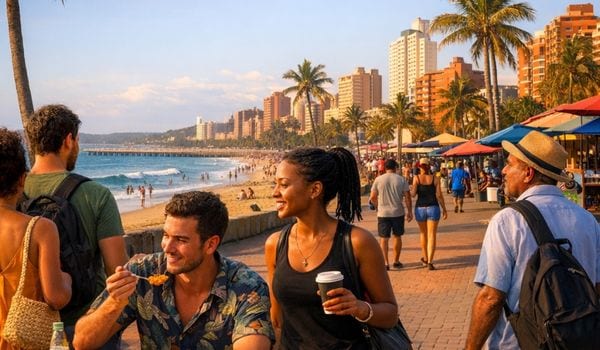
Durban rarely makes it onto digital nomad shortlists, and that is part of its appeal. Umhlanga, the polished coastal suburb north of the city, has become the default landing spot for remote workers who want ocean proximity, modern buildings, and a lower crime profile than central Durban. Morningside and Berea, closer to the old city center, offer colonial-era architecture, tree lined streets, and easy access to the cafes and nightlife along Florida Road, at a noticeably lower price point than Umhlanga. La Lucia sits just north of Umhlanga and trades a bit of walkability for quieter streets and larger units. All of them share one thing Cape Town and Johannesburg cannot offer at these prices, which is warm water swimming for most of the year.
The trade offs are real and worth naming plainly. Durban's public transport is limited, which means most remote workers end up needing a car or relying heavily on ride hailing apps. Load shedding still shows up on the schedule here as it does across South Africa, though less disruptively than a few years ago. And central Durban itself has a rougher edge than the northern suburbs, which is exactly why most digital nomads and expats concentrate in Umhlanga, Morningside, and La Lucia rather than downtown.
We cover all of it in the full visual guide, the specific rent ranges by suburb, the same Remote Work Visitor Visa route that applies across South Africa, the coworking spots concentrated around Umhlanga Ridge and Morningside, our full Geo-Metric and Efficiency Scores, and the honest friction points that surface after month three of actually living here rather than visiting for a week. |
 |
Priya told us she almost skipped Durban entirely while researching South African cities, drawn instead toward Cape Town's marketing. She said the thing nobody had told her going in was how much the ocean changes the daily rhythm of remote work, how a lunch break turns into an actual walk on sand instead of a scroll through your phone.
That is the case for Durban in a sentence. Not flashier than Cape Town, not more efficient than Johannesburg, just quietly livable in a way that rewards people willing to look past the marketing gap. Have you spent time in Durban, or is this the first you are hearing it mentioned as a real option? Tell us in the comments, especially if you have lived there and our numbers do not match your experience.
💡 Answer to Trivia
Roughly one in four Durban residents traces their roots to that 1860s migration, making it the largest population of Indian descent outside India anywhere in the world.
Happy travels, explorers!! |
0 Comments
Join the conversation
Be the first to comment
Share your thoughts above.